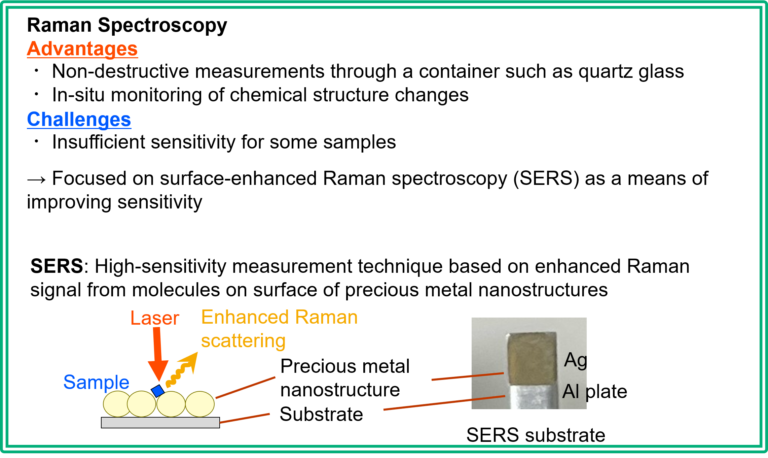

Principle of HPLC + Raman
JASCO LC with Palmtop
Raman spectrometer to monitor the reaction system of flow synthesis process
Introduction
Organic synthesis is conventionally carried out by batch methods, but continuous-flow synthesis has recently been attracting attention because it is easy to scale up chemical reactions and allows stable production of the desired compound.
We have developed a new measurement system using the compact JASCO Palmtop Raman spectrometer to monitor flow synthesis.
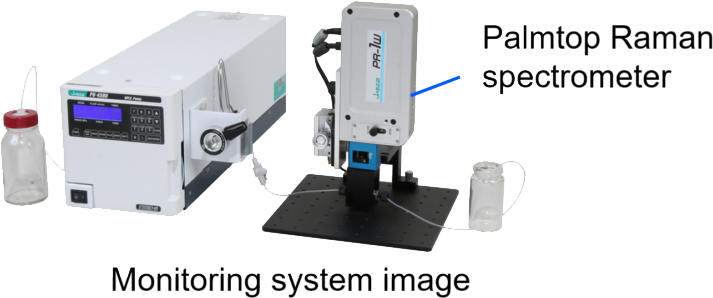
Reaction monitoring using JASCO Palmtop Raman spectrometer
Aldol reactions were monitored under batch conditions to ensure that reactions were traceable.
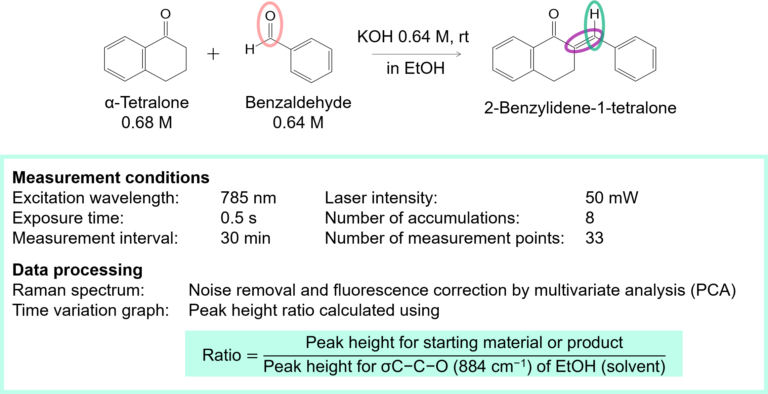
Result
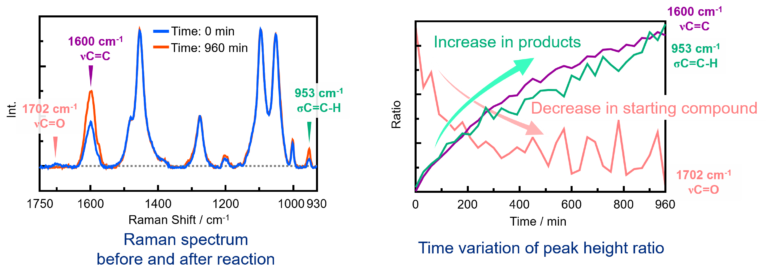
Decrease in starting compound and increase in products were observed.
The smaller the intensity of the peak of interest, the smaller the Signal-to-noise ratio in the time variation graph.
Reaction monitoring was confirmed to be possible using the JASCO Palmtop Raman spectrometer.
JASCO Integrated HPLC system: LC-4000
The concept of the integrated LC-4000 series HPLC provides key separation platforms at 35 MPa, 70 MPa and 130 MPa which correspond to conventional HPLC, the increasingly popular Rapid Analysis (RHPLC) and sub 2 μm UHPLC, respectively.
With JASCO’s long history of spectrometer development, you will find that each detector is well designed; these next generation detectors employ the latest optical and electronic technologies for high sensitivity, excellent stability and easy maintenance.
HPLC detector lineup:
- UV-Visible HPLC Detectors:
The UV-visible HPLC detectors both use an advanced Czerny-Turner monochromator with dual wavelength and scanning functions.
Baseline change due to refractive index is minimized by the flow cell design, and fluctuation from changes in environmental and lamp temperature
are reduced with a regulated lamp housing and temperature-controlled cell.
- PDA HPLC Detectors:
When used with ChromNAV 2.0 CDS the PDA detector offers multi-functional analysis with a variety of functions such as spectral analysis, library
search for peak identification, peak purity and multi-wavelength quantitation.
- Fluorescence HPLC Detectors:
A complete redesign of the optics and electronics, as well as removing the effects temperature fluctuation with a new temperature regulated cell
body has led to the highest sensitivity with stable detection.
- Refractive Index HPLC Detectors:
The refractive index detectors include an optical system mounted in a precise temperature-regulated housing to eliminate the influence of
changes in ambient temperature. Both detectors are fully stable just one hour after powering on.
- Circular Dichroism HPLC Detector:
The CD-4095 is a unique HPLC CD detector for measuring circular dichroism developed from the market leading J-Series circular dichroism
spectropolarimeters. Optically active compounds with a chromophore close to a chiral center may absorb circularly polarized light, which can be
detected with excellent sensitivity and selectivity. When chiral compounds are measured using a UV-Visible detector, the d- and l- enantiomers
cannot be distinguished even when separated by a chiral column, however the CD-4095 CD detector makes it possible to positively distinguish
between the d- and l- enantiomers by measuring their positive and negative peaks.
- Optical Rotation Detector:
The OR-4090 chiral detector measures the angle of rotation of plane polarized light caused by optical active isomers and is useful for chiral
compounds with no absorption. The wide wavelength range from 350 – 900 nm also allows measurement of a wide variety of samples.
The
specially designed SERS cell makes JASCO Palmtop Raman spectrometer PR-1w be a
LC detector.