



Principle of digital polarimeter
Advantages of using line spectral light sources for measuring the optical rotation
1. Sodium lamp
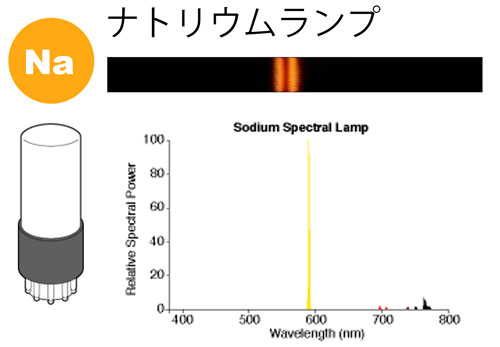
Also known as D-line, it exhibits strong line-spectral emission at wavelengths of 589.6 nm and 589.0 nm and does not emit light at other wavelengths. Therefore, it has been the primary light source for optical rotation measurement. Furthermore, when expressing optical rotation or specific rotation, only the Sodium D-line can be recorded as "D".
2. Mercury lamp
Because there are line spectra from ultraviolet to visible range, it is also used as a light source for Polarimeters. When used in conjunction with appropriate filters, optical rotation measurement can be performed at wavelengths of 365, 405, 436, and 546 nm.

3. Halogen lamp, WI
As a continuous wavelength light source, it is necessary to select different wavelengths through a filter to measure optical rotation. However, the bandwidth transmitted through the filter is much wider than a line-spectrum light sources, which will inevitably lead to some measurement error.
The following table lists the optical rotation of pirarubicin measured by sodium lamps and halogen lamps, and the optical rotation value will differ depending on the light source. This is because halogen lamps have a wider bandwidth transmitted through the filter.
|
Light source |
Optical rotation [deg] |
Specific rotation [deg・cm2・dag−1] |
|
Sodium D-line |
+0.2066 |
[α]D20 : +206.6 |
|
WI + filter 589 nm |
+0.1967 |
[α]58920 : +196.7 |

4. LED
LED is a monochromatic light with a bandwidth wider than line-spectra and long lifespan, low heat generation, and short warm-up time. When paired with an interference filter, it can also be used to a limited extent in optical rotation measurement.
However, as shown on the outer of the diagram below, the peak of the LED's emitted wavelength (dark blue) does not necessarily completely overlap with the filter's transmission range (pink). Therefore, the transmitted light has a wider bandwidth and a more irregular shape (shown inside the diagram below).

5. Why use line spectra in Polarimeter
Taking Pirarubicin as an example as shown in the follow figure, the blue line represents the specific rotation of the sample at different wavelengths, the red line represents the D-line, and the green line represents the 589 nm light from a filter.
Since line-spectra is almost no bandwidth, optical rotation can be measured at a very pure specific wavelength. The 589 nm light with a bandwidth from a filter, the optical rotation will be average of the entire wavelength range.
If the specific rotation of the sample changes drastically at different wavelengths, or if the transmission bandwidth of the filter is different, it will lead to larger errors or instability in the optical rotation measurement.

6. Conclusion
JASCO P-4000 series offers sodium and mercury lamp for line spectral, further enhancing the stability and reproducibility of optical rotation measurements.